




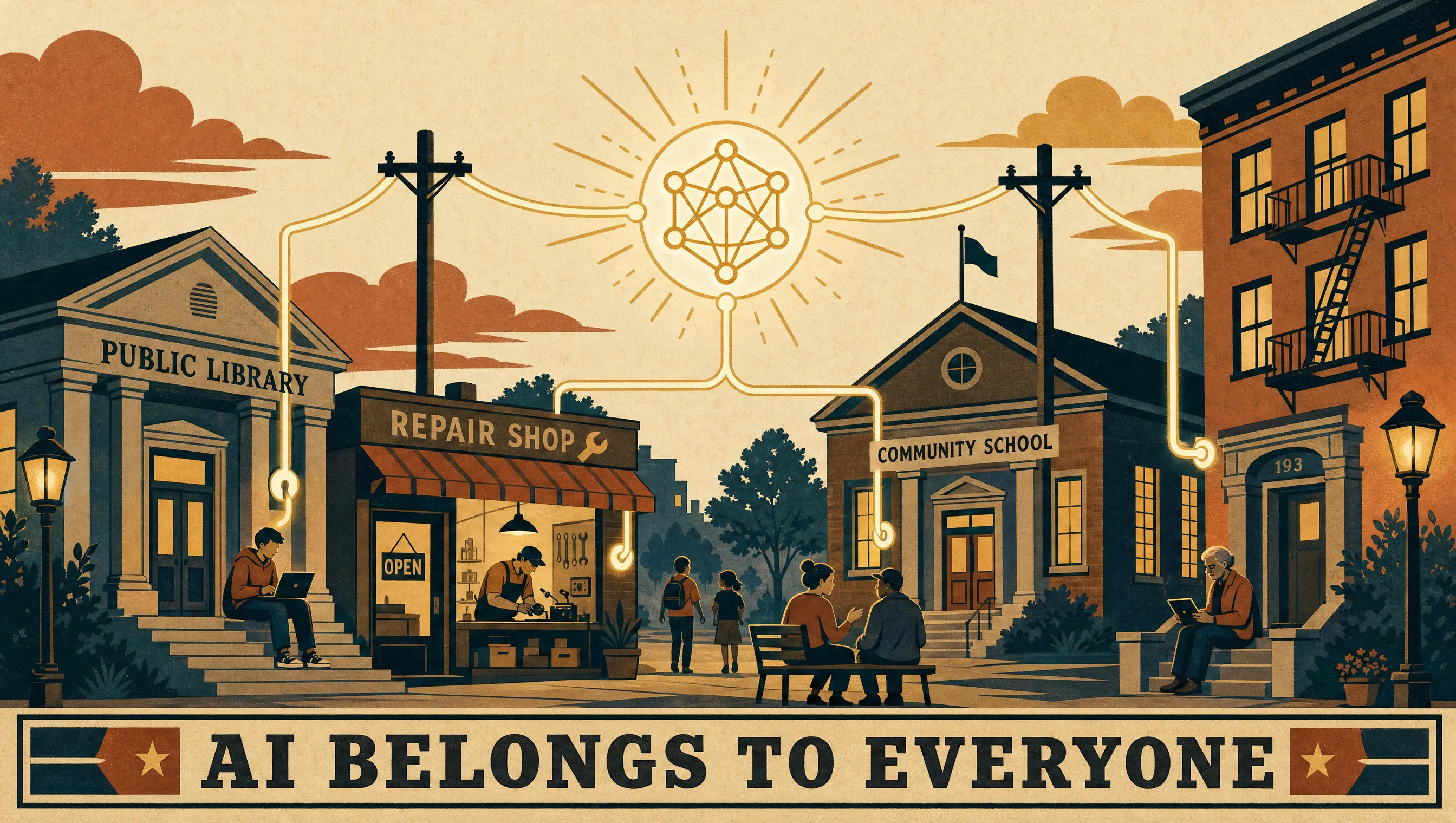
This is the second half of an argument I started in the last piece: American corporations are building AI to fire you, and they are spending more than six hundred billion dollars a year doing it. This piece is about the part nobody in Silicon Valley wants to say out loud — the alternative already exists, it works, and the country running it hardest is the one Washington told you to be afraid of.
The question was never going to be “AI: yes or no.” The question is who owns it. And right now there are two answers on the table. One rents intelligence back to you by the token. The other hands it to you like a library card.
The Enclosure of the American Internet, Part Two
We have seen this heist before. The internet your taxes paid for — DARPA’s network, the NSF backbone, the public university research that trained a generation of engineers — got handed to private platforms, and within twenty years a handful of companies owned the town square, the mall, and the mail. Now the same crew is running the same play on machine intelligence: train on the collective work of millions of people, then lock the result behind an API key with a terms-of-service contract you cannot negotiate.
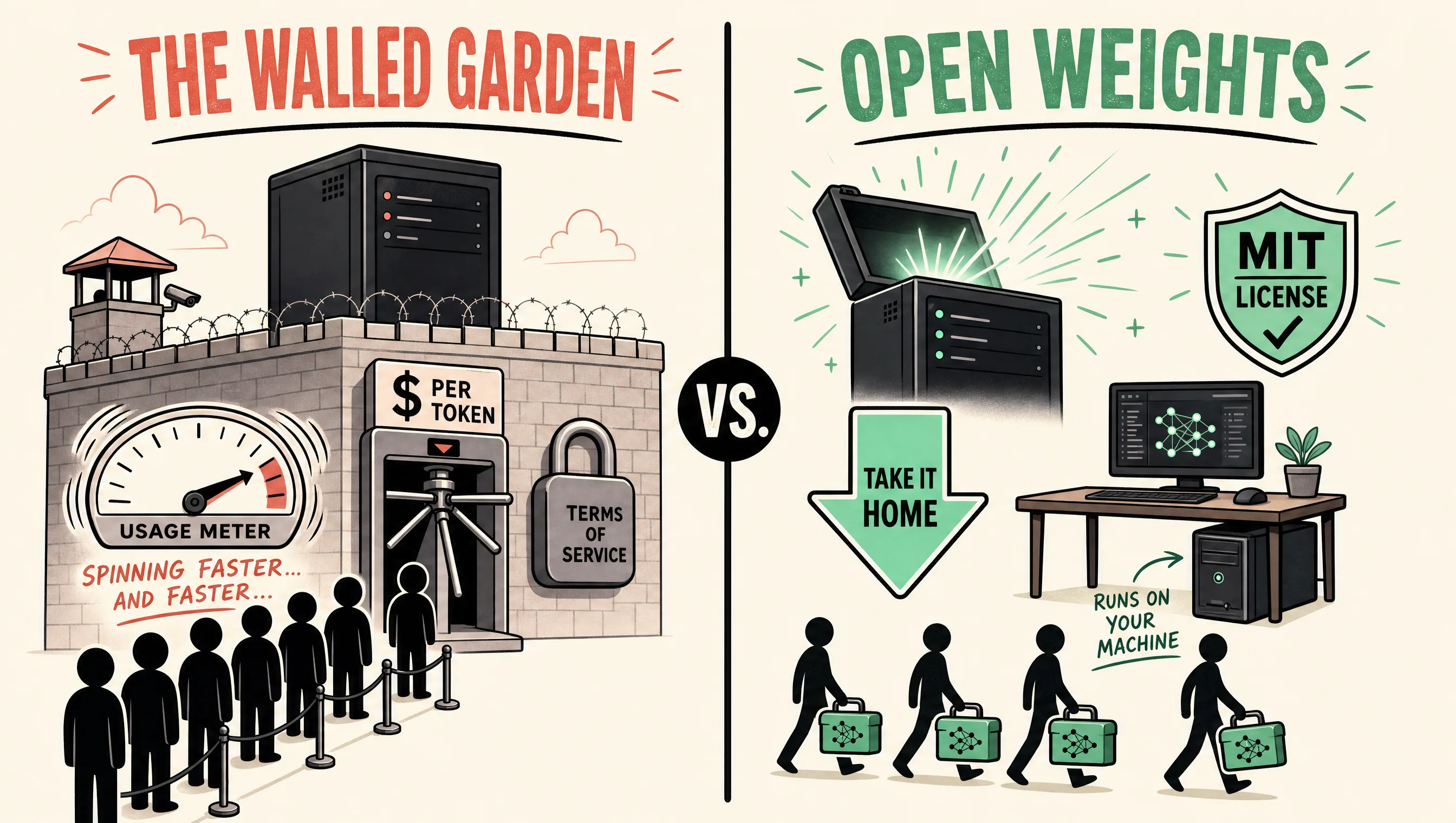
That is the walled garden: per-token pricing, rate limits, model deprecations that break your business overnight, and a running log of every question you ever asked. You don’t own any of it. You can’t audit it. If the company decides your use case is a policy problem, or just unprofitable, you’re done. We fought this exact fight in the repair world — manufacturers locking schematics and pairing parts so you can’t fix what you own. We won it by refusing the lock. Same enemy, bigger scale.
What China Actually Did
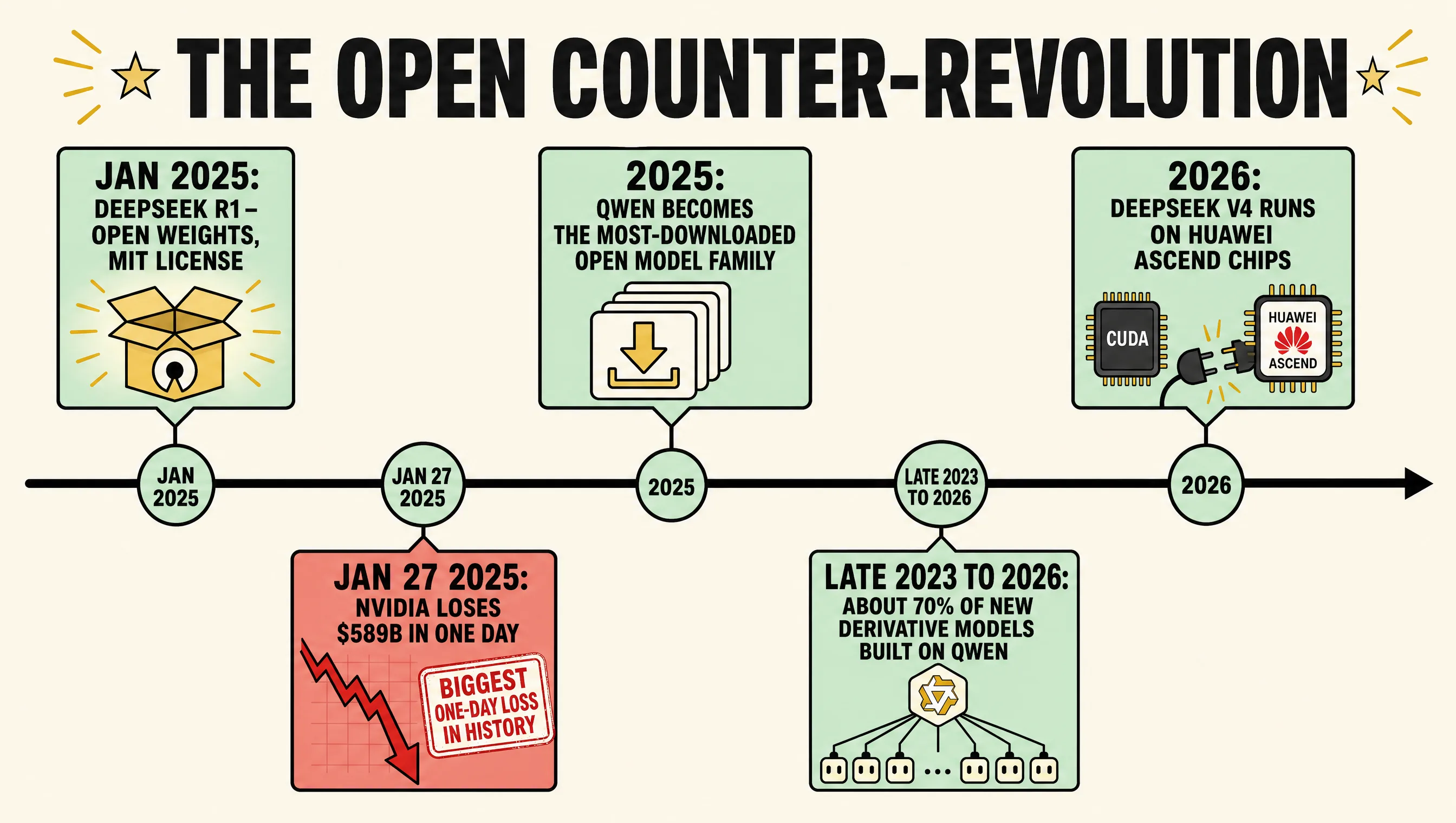
In January 2025, a Hangzhou lab called DeepSeek released R1 — a frontier-reasoning model — under an MIT license. Not “freemium.” Not “research only.” The actual files, downloadable, modifiable, commercially usable, no permission slip required. DeepSeek had already reported that the final training run of its V3 base model cost under $6 million in compute — a number Silicon Valley met with disbelief, then with imitation.
The market’s nervous breakdown arrived within the week. On January 27, 2025, Nvidia lost roughly $589 billion in market value in a single day — the largest one-day loss any company in history has suffered. Read that again. Not a war, not a bankruptcy. A free download. That is how fragile the story of “AI requires a trillion dollars and our API” always was.
And it was not one lab. Alibaba’s Qwen team ships models under Apache 2.0 and became the most-downloaded open model family on the planet — by late-count trackers, roughly 70% of new derivative models built between late 2023 and 2026 are Qwen-based. Baidu open-sourced ERNIE. Moonshot, Zhipu, MiniMax followed. In 2026 DeepSeek’s V4 line runs on Huawei Ascend chips — a whole stack built to exist outside anyone’s permission. Labs compete on quality and price instead of competing on cage strength. The Register called it a pincer. It is more honest to call it a commons.
Beneath the labs sits the state’s part of the strategy, and this is the piece America has no equivalent of: China classifies AI as infrastructure. National compute corridors — the “East Data, West Computing” program — move training capacity the way the grid moves electricity, planned like rail and power because that is what compute has become. The output of that system is open weights the whole world runs on, including half of Silicon Valley’s own developers.
Let me save the bad-faith replies some time: no, I am not romanticizing the Chinese state. It has its own surveillance apparatus and its own accountability problem, and you should not have to trade one unaccountable landlord for another. The lesson is not “China good.” The lesson is that when a society decides AI is public infrastructure instead of a rent stream, the technology behaves completely differently — cheaper, faster to spread, impossible to enclose. That decision is the transferable part. Nothing about it requires their politics. Everything about it requires taking ownership away from the people currently hoarding it.
Why Open Weights Are a Community Good
Strip the geopolitics out and the argument is wooden-table simple. Open weights mean:
- No rent.A model that runs on hardware you own costs the price of the electricity. No per-token meter, no surprise price hike, no “your tier has been discontinued.”
- No telemetry. A local model does not phone home with your questions. Your medical records, your legal troubles, your business files stay in the building.
- No permission. Community groups can fine-tune models for Haitian Creole, for local ordinances, for shop-floor repair manuals — work no quarterly earnings target would ever prioritize.
- No kill switch. A downloaded model cannot be deprecated out from under your clinic, your school, or your shop.
Even OpenAI — the cathedral of the closed model — felt the pressure and released open-weight models of its own in 2025. When the church starts handing out Bibles, you know the printing press already won somewhere else.
And the punchline nobody wants printed: Washington’s answer to all this was to ban DeepSeek from government devices and try to outlaw state AI regulation for a decade — a move so raw even the U.S. Senate voted it down 99 to 1. Protecting the enclosure turned out to be the one bipartisan instinct left.
What People-Owned AI Looks Like Here
Americans have built public technology before, and we did it best when we treated it like a utility. The playlist is not exotic:
- Public compute as a utility.Municipal and regional compute the way we do water and electricity — and remember, rural electric co-ops are how the countryside got power when the market said it wasn’t profitable. Same math, different century.
- Open by default for public money. If taxpayers funded the research, the weights ship open. No more publicly funded enclosures.
- Public AI like public broadcasting. An independent, publicly funded model — audited, ad-free, answerable to citizens instead of shareholders. PBS, but for intelligence.
- Libraries hosting local models. Every branch library already bridges the digital divide. Put open models on library hardware and every kid in this city gets frontier AI without a credit card.
- A data dividend. The models were trained on all of us. If they generate rents, the rents flow back — Alaska already runs this playbook with its oil fund.
None of that is utopian. Every one of those institutions already exists in some form, built by people who were told the market would handle it. The market’s answer, as I documented last time, is a $600 billion machine whose flagship feature is a smaller payroll.
The Fork in the Road
Intelligence is about to be the most valuable input to everything — medicine, education, engineering, repair. Societies get exactly one chance to decide whether that input is owned or shared, and the window is now, while the open-weight ecosystem is still alive and the closed one is still begging for trillion-dollar bailouts. Choose the walled garden and every human on Earth becomes a tenant. Choose the commons and the tool that thinks belongs to whoever shows up to use it.
I know which side a repair shop is on. We have never once fixed a computer by asking the manufacturer’s permission — and the machines we freed taught everyone what they could do without one.
Frequently Asked Questions
What does “open weights” mean?
It means the trained model files are published for anyone to download, inspect, modify, and run on their own hardware, usually under a permissive license like MIT or Apache 2.0 — instead of only being reachable through a paid, gated corporate API.
Why is China releasing open AI models?
Chinese labs like DeepSeek, Alibaba’s Qwen team, Moonshot, and Zhipu treat open weights as strategy: adoption everywhere compounds their ecosystem, and the state treats AI as public infrastructure, building shared national compute the way it builds grids and rail.
What happened to Nvidia when DeepSeek R1 came out?
On January 27, 2025, after DeepSeek released R1 under an MIT license built at a fraction of assumed costs, Nvidia lost roughly $589 billion in market value in one day — the largest single-day loss any company has suffered.
How could AI be owned by the people?
Open weights by default, public and municipal compute utilities, community cooperatives running local models, and requiring publicly funded AI research to be published openly — the same pattern that gave us libraries, public power, and the open internet.
Sources
- Bloomberg — Nvidia’s $589 Billion DeepSeek Rout Is Largest in Market History
- Forbes — China’s DeepSeek V4 and Qwen Reshape the Open-Source AI Race
- Stanford HAI — Beyond DeepSeek: China’s Diverse Open-Weight AI Ecosystem
- The Register — China Turns Up The Heat With Open Model Blitz
Contact Us
Want help setting up a local, open-weight model for your business — one that runs on your own hardware and reports to nobody? That is literally our kind of job.
We Accept Donations
Send your crypto donations to Maxiaxxx.sol. All funds help towards moving our site to decentralized.