




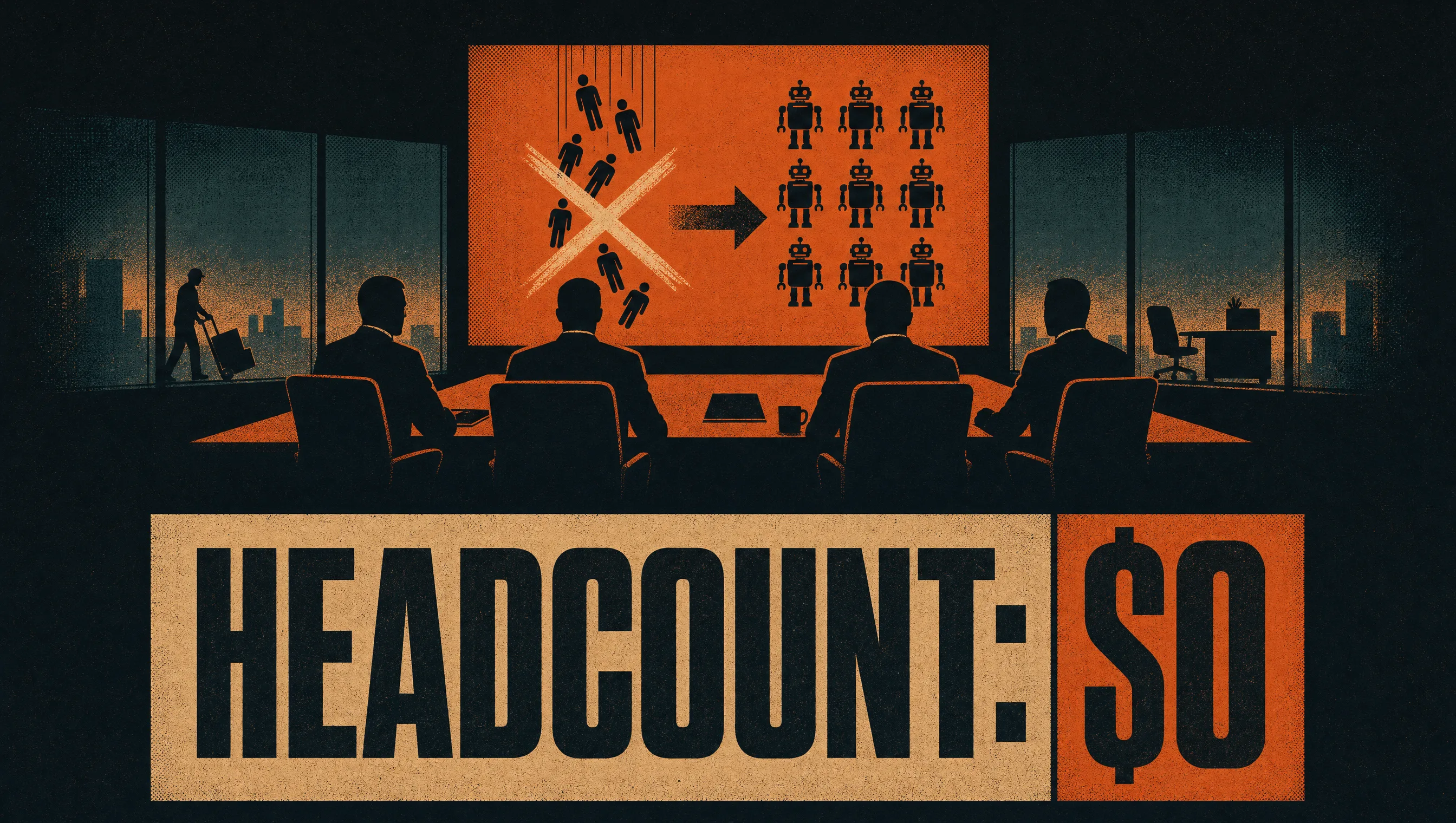
Here is the claim, delivered plainly: corporations are not building artificial intelligence to make your life better. They are building it to make your job disappear. Every press release about “empowering people with AI” is a layoff notice wearing a nice shirt. The race to AGI is not a science project — it is the largest union-busting operation ever funded, and the unions they are busting are everyone who works for a living.
I run a computer repair shop in Brooklyn. I read earnings calls the way other people read box scores. And I am done pretending the people spending hundreds of billions of dollars on data centers are doing it for you.
Follow the Money, Not the Press Release
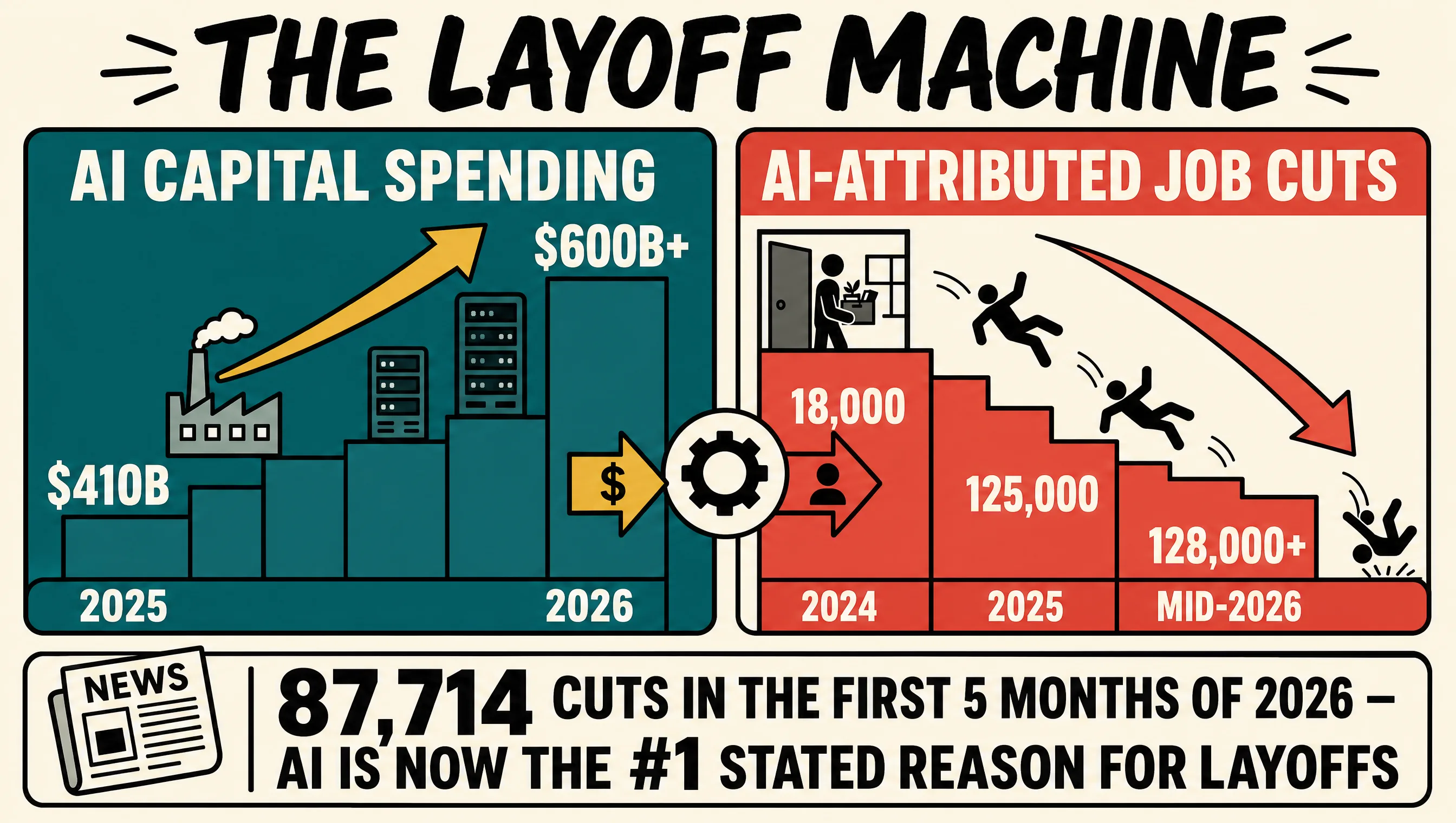
Here is what the “AI revolution” costs. In 2026, the combined AI capital expenditure of just four companies — Microsoft, Alphabet, Amazon, and Meta — is projected between roughly $600 and $760 billion. Goldman Sachs puts the coming multi-year tab for the big four at around $5.3 trillion. That is not research money. That is machinery bought for one purpose: to do work without paying the people who used to do it.
Nobody spends seven hundred billion dollars to give you a better homework helper. You spend it because every dollar of wages it replaces comes back as margin. The spreadsheet was run before the press release was written.
They Already Told On Themselves
Executives keep saying the quiet part at conferences, then acting shocked when anyone quotes them. The receipts go back years:
- 2023, IBM:the CEO announced a hiring pause on roles AI could handle — about 7,800 back-office jobs, by the company’s own estimate.
- Meta:the “Year of Efficiency” cut roughly 21,000 people across two rounds, then Meta started pouring tens of billions into AI data centers and told investors the savings would fund it.
- February 2024, Klarna: the CEO bragged its AI assistant did the work of 700 customer-service agents. A year later the company admitted it had cut too deep — service quality cratered and it quietly started rehiring humans. They ran the experiment on customers, on workers, and on the truth.
- May 2025, Salesforce:Benioff said AI was already doing 30–50% of the work at Salesforce. Not “helping with.” Doing.
- May 2025, Daisy: the CEO told staff AI would shrink the workforce from about 1,200 to 800 within a year and a half, and told team leads to give replaced employees 30–60 days of runway. The memo leaked because of course it did.
- July 2025, Microsoft: about 9,000 more people cut in a single round — while the company was mid-way through an $80 billion AI infrastructure year and buying back its own stock at a record pace.
And the CEOs building the frontier itself? Anthropic’s own chief told press in 2025 that AI could eliminate half of entry-level white-collar jobs within five years and push unemployment toward 10–20%. He said it as a warning, then kept building the thing he was warning us about. That is the industry’s conscience in one sentence: full awareness, zero restraint, continued fundraising.
The Numbers Do Not Lie, So They Bury Them
Trackers that tag layoff announcements attribute roughly 18,000 job cuts to AI in 2024. In 2025 it was about 125,000. By the middle of 2026 — before the year was half over — the count had already passed 128,000. CNBC reported that AI is now the single most common reason companies give for cutting jobs: 87,714 cuts in just the first five months of 2026. Not a side effect. The headline reason, stated out loud, on the record.
So the next time a spokesperson says AI will “create new opportunities,” ask them to name the department that got bigger this quarter. Ask which town got the hiring announcement to match the data center. They will change the subject to AGI. Always AGI.
The Euphemism Pipeline
Corporate language is designed to make firing sound like physics. Nobody gets “fired” anymore. Roles are “sunset.” Teams are “right-sized.” The company is going “AI-first,” which is a phrase that can only mean “people-second, people-eventually-never.” The pitch always follows the same four steps:
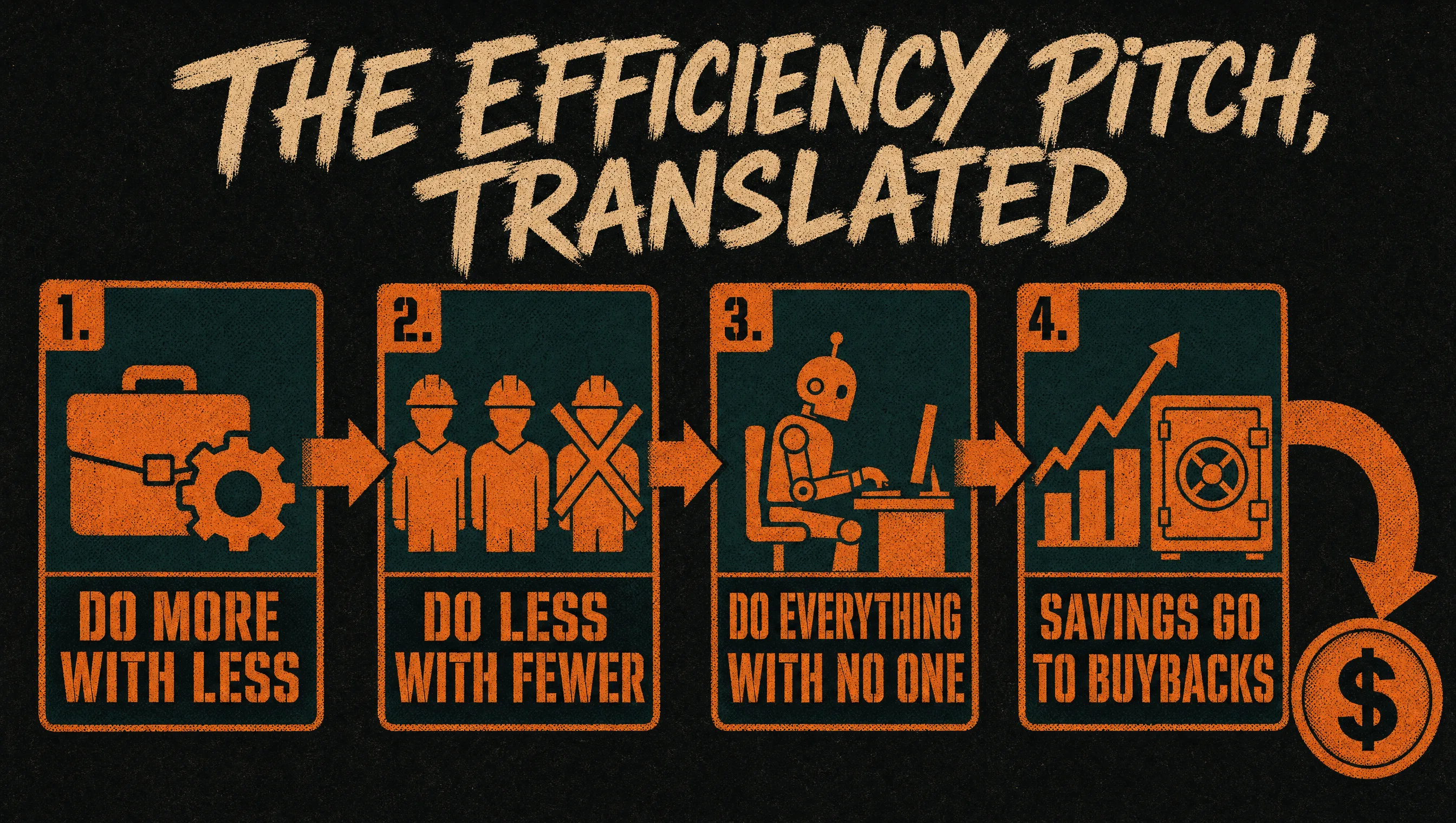
“Do more with less” is a promise to you. “Do everything with no one” is the plan for you. The gap between those two sentences is where your career used to be.
AGI Is the Distraction They Pray To
Every serious question about layoffs, water use, energy rates, or who owns these systems gets waved away with two words: AGI is coming. The promise of a god-machine justifies any expense and answers any objection. It is the most effective marketing asset ever constructed, because it cannot be falsified until it fails, and when it fails the money is already spent.
Notice what the AGI story conveniently leaves out: if a machine that can do all human work actually arrives, who owns it? Under the current arrangement, a handful of companies would own the entire productive capacity of the human species and rent it back to us by the token. That is not innovation. That is the final enclosure — the last commons, which is human labor itself, fenced off and metered. The more honest version of their pitch is:give us trillions now, and in exchange, one day you won’t need to pay anyone anything, including you.
AGI might arrive someday. But the layoffs are not arriving someday. They are a Tuesday. They are this quarter’s guidance. The gap between the science-fiction story and the spreadsheet reality is where this entire industry hides.
Who Buys the Products When Nobody Has a Paycheck?
Here is the contradiction they refuse to answer. Their business model is: replace wages with machines, keep the price of subscription software roughly the same, and book the difference. But their customers are the very households and businesses whose wages they just deleted. You cannot fire your customers and your workers simultaneously and call it a growth strategy. This ends one of two ways: collapse, or a society that finally decides the machines work for everyone instead of three boardrooms.
I fix machines for a living. Real ones, with screws and solder. And I can tell you what no earnings call will admit: when your laptop dies, a language model does not hold the screwdriver. The trades, the repairs, the care work, the physical world — the economy they are so eager to empty of people is the same economy that keeps their servers cool and their buildings standing.
What Progress Actually Looks Like
The technology is not the enemy — I am literally a robotics shop saying this. The ownership is. AI trained on the collected writing, code, and knowledge of millions of people should not belong to four companies. It should be a common resource, the way libraries, roads, and the internet itself were supposed to be. Open-weight models you can download, inspect, and run on your own hardware already exist, and they are quietly proving that the closed, metered, walled-garden model is a choice, not a law of nature.
That fight has a shape we know well in the repair world. Manufacturers lock schematics, block parts pairing, and call independent repair a security risk — the exact same playbook as locking model weights behind an API. If you want to see how enclosure loses, read how we fight it every day. The answer to “who owns AI” is the same as “who owns your right to repair”: you do.
I wrote a whole second piece on the alternative — how China treats AI as public infrastructure with open weights while American firms enclose it, and what a people-owned version could look like here: AI Should Belong to the People: What China’s Open-Weights Model Gets Right.
Frequently Asked Questions
Why do corporations invest in AI?
The dominant motivation is labor cost elimination. With 2026 hyperscaler AI capex projected above $600 billion and AI now the most commonly cited reason for layoffs, the business case being purchased is headcount replacement — machines instead of wages.
How many jobs have been cut because of AI?
Roughly 18,000 cuts were attributed to AI in 2024, about 125,000 in all of 2025, and around 128,000 by mid-2026 — the first half of 2026 alone outpaced all of 2025.
Is AGI actually close?
Nobody knows, including the CEOs selling the timeline. AGI promises function as a capital-raising narrative that justifies enormous compute spending today, while the automation actually shipping is trained to replace specific jobs, not to think.
What is the alternative to corporate-controlled AI?
Open-weight models anyone can download, audit, and run locally, plus public and community-owned compute — treating AI like a utility such as electricity or libraries instead of a product rented by the token.
Sources
- Futurum Group — AI Capex 2026: The $690B Infrastructure Sprint
- Statista — Big Tech’s AI Spending to Reach $760B in 2026
- Yahoo Finance / Goldman Sachs — $5.3 Trillion Hyperscaler Capex Projection
- Layoffs.fyi — Tech Layoff and AI-Attribution Tracker
Contact Us
Run a shop, a co-op, or a small business trying to use AI without selling your people out? Talk to us here.
We Accept Donations
Send your crypto donations to Maxiaxxx.sol. All funds help towards moving our site to decentralized.